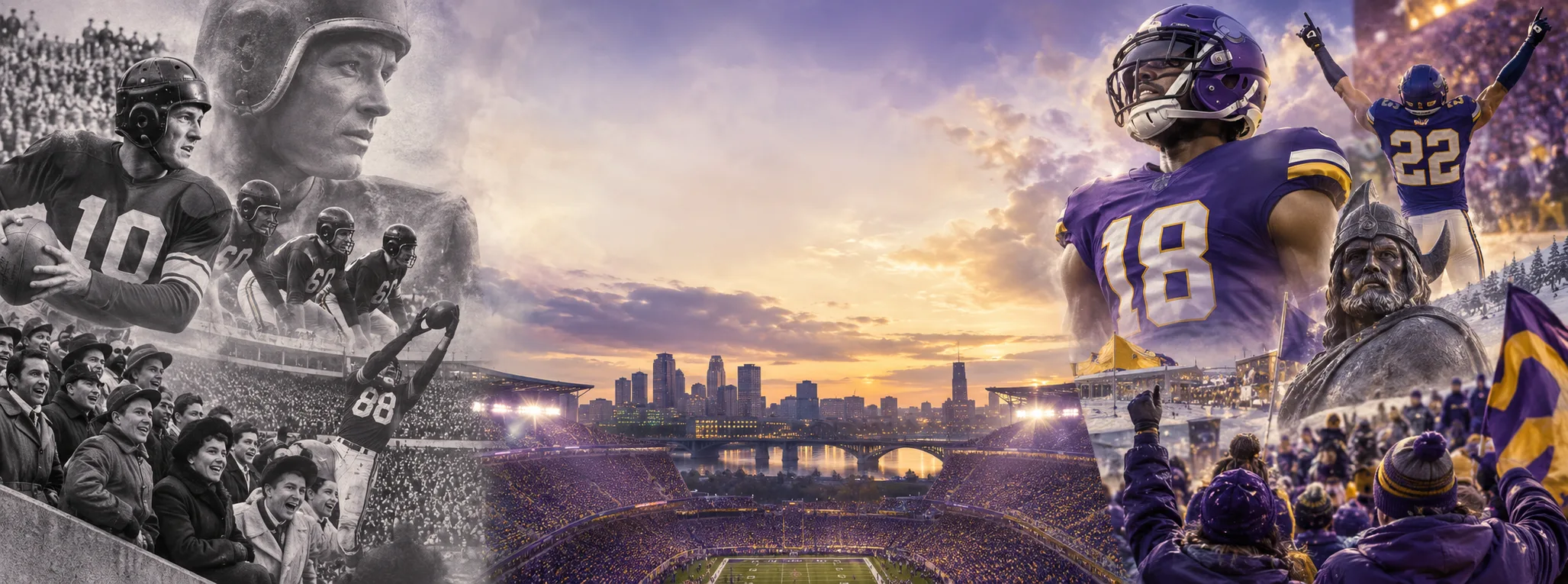
Six decades of Minnesota football — from a cold expansion field in Bloomington to the horn blowing downtown. Iconic players, unforgettable games and the seasons that made the Vikings what they are.
1961First NFL season
1969NFL Championship
4Super Bowl appearances
2016U.S. Bank Stadium opens
The Franchise
Minnesota was awarded an NFL franchise in 1960 and began play in , joining the league as an expansion team based in the Twin Cities. The Vikings have been a fixture of the NFL's black-and-blue division ever since — first the NFL Central, today the NFC North — and their rivalries with Green Bay, Chicago and Detroit are among the oldest running arguments in American sport.
The team has reached four Super Bowls — IV, VIII, IX and XI — and has not yet won one. What Minnesota does have is one of the most distinctive identities in football: the Purple People Eaters, purple and gold, the Gjallarhorn, and a stadium of 66,000 people clapping out the Skol chant in unison.
The Vikings played their first regular-season game on at Metropolitan Stadium and beat the Chicago Bears 37–13, with rookie quarterback Fran Tarkenton coming off the bench. Norm Van Brocklin coached the early teams; Bud Grant took over in 1967 and the turnaround was immediate. Minnesota won its first division title in 1968, and in went 12–2 and won the NFL Championship, beating Cleveland 27–7 in the cold at the Met — the franchise's only league title, earned in the last season before the AFL–NFL merger took full effect.
Norm Van Brocklin
Bud Grant
1969 NFL Champions
Three Super Bowls, four in all
The defining decade. Bud Grant's Vikings reached Super Bowl IV after the 1969 season, then Super Bowls VIII, IX and XI in the space of four years, losing to Kansas City, Miami, Pittsburgh and Oakland respectively. Fran Tarkenton returned from the New York Giants in 1972 and ran the offence; Chuck Foreman gave it a back who could do everything. The Purple People Eaters made the defensive line famous, and Alan Page became the first defensive player named Associated Press NFL Most Valuable Player, in .
Fran Tarkenton
Chuck Foreman
Four Super Bowls
Indoors, and one more deep run
The Vikings left Metropolitan Stadium after the 1981 season and moved into the Hubert H. Humphrey Metrodome in downtown Minneapolis for . Bud Grant retired, returned for a season, then retired for good. The decade's high point came in , when a wild-card Minnesota team won two road playoff games before losing the NFC Championship Game at Washington. Keith Millard, Chris Doleman and a young Randall McDaniel were the core of the next great Vikings teams.
Metrodome era
Chris Doleman
1987 NFC title game
15–1, and the one that got away
Dennis Green took over in and made the playoffs in eight of his ten seasons. The peak was : a 15–1 team with Randall Cunningham throwing to Cris Carter and rookie Randy Moss, scoring a then-NFL-record 556 points. It ended in the NFC Championship Game at the Metrodome, a 30–27 overtime loss to Atlanta that Minnesota fans still measure other disappointments against. John Randle and Robert Smith made the era's other highlights.
Randy Moss
Cris Carter
John Randle
Favre, and another overtime
The decade opened with a run to the NFC Championship Game after the season and a 41–0 loss at the New York Giants. It closed with one of the strangest and best Vikings seasons of all: , Brett Favre at 40 years old, a 12–4 record, and an NFC Championship Game in New Orleans that Minnesota lost in overtime. Adrian Peterson arrived in 2007 and ran for 296 yards against San Diego in his rookie year — still the most rushing yards in a single NFL game.
Brett Favre
Adrian Peterson
2009 NFC title game
A new home and the Minneapolis Miracle
Adrian Peterson ran for 2,097 yards in and was named NFL Most Valuable Player. The Metrodome came down; the Vikings played two seasons outdoors at TCF Bank Stadium before U.S. Bank Stadium opened in . Then came : 13–3, the league's best defence, and a divisional-round game against New Orleans that ended with Stefon Diggs catching a Case Keenum throw and running it in as time expired — the Minneapolis Miracle. The NFC Championship Game in Philadelphia the following week did not go the same way.
U.S. Bank Stadium
Minneapolis Miracle
Skol chant
Jefferson, O'Connell and the comeback
Justin Jefferson turned into the best receiver in football almost immediately, leading the NFL with 1,809 receiving yards in and winning Offensive Player of the Year. Kevin O'Connell's first season produced a 13–4 record, an NFC North title and, in December, the largest comeback in NFL history: down 33–0 at half-time to Indianapolis, Minnesota won 39–36 in overtime. The team sits 8–3 after a 27–24 win over Chicago.
Justin Jefferson
Kevin O'Connell
33–0 comeback
The Front Four
The Purple People Eaters
Carl Eller and Jim Marshall at the ends, Alan Page and Gary Larsen inside: the defensive line that gave the Vikings of the late 1960s and 1970s their identity, and the league one of its great nicknames. Their unofficial motto — meet at the quarterback — described the method exactly.
Page was named NFL Most Valuable Player in 1971, the first defensive player to win the award. Marshall started 270 consecutive regular-season games, an ironman run that stood for decades. Eller and Page both went to the Pro Football Hall of Fame, and all four are part of why purple still means something specific to people who watched football in that era.
The Vikings Ring of Honor was established in 1998 and hangs inside U.S. Bank Stadium. A selection of the names below — this is not the complete list.
Quarterback
Fran Tarkenton
Drafted in the franchise's first season, traded to the Giants, and brought back in 1972 to run the offence through the Super Bowl years. A scrambler before the league had a word for it, and a Hall of Famer.
Defensive tackle
Alan Page
The first defensive player named NFL Most Valuable Player, in 1971. Later a Minnesota Supreme Court justice — a second career that says as much about him as the first.
Defensive end
Carl Eller
The left end of the Purple People Eaters and one of the most feared pass rushers of the 1970s. Inducted into the Pro Football Hall of Fame.
Defensive end
Jim Marshall
270 consecutive regular-season starts. He captained the defence for two decades and never came off the field.
Safety
Paul Krause
81 career interceptions — still the NFL record. A centre fielder in the deep secondary who read quarterbacks better than anyone of his generation.
Head coach
Bud Grant
Coached the Vikings from 1967, took them to four Super Bowls and refused to let his teams use sideline heaters. The definition of the franchise for a generation.
Wide receiver
Cris Carter
"All he does is catch touchdowns." Twelve seasons in Minnesota, a Hall of Fame career, and the veteran half of the 1998 receiving corps.
Wide receiver
Randy Moss
Caught 17 touchdowns as a rookie in 1998, a rookie record, and changed how defences had to be built. Straight cash.
Defensive tackle
John Randle
Undrafted, relentless, and impossible to block one-on-one. He talked through every snap and backed all of it up.
Guard
Randall McDaniel
A Hall of Fame guard who made the Pro Bowl year after year, in a two-point stance nobody else could copy.
Running back
Chuck Foreman
The complete back of the Super Bowl teams: runner, receiver and the reason those offences had an answer on third down.
Running back
Adrian Peterson
2,097 rushing yards and the MVP award in 2012, a year after a torn knee. Holds the NFL single-game rushing record with 296 yards.
Franchise Records
Scroll the table sideways to see every column.
Selected Minnesota Vikings franchise and league records
Record
Holder
Mark
Year
Rushing yards, season
Adrian Peterson
2,097
Rushing yards, game NFL record
Adrian Peterson
296
Receiving yards, season
Justin Jefferson
1,809
Touchdown catches, rookie NFL rookie record
Randy Moss
17
Career interceptions NFL record
Paul Krause
81
1964–1979
Consecutive starts
Jim Marshall
270
1961–1979
Team points, season
1998 Vikings
556
Paul Krause's 81 interceptions include four seasons with Washington before he joined Minnesota in 1968. Records shown are the ones we can source confidently; this is not a complete franchise record book.
The first regular-season game in franchise history, at Metropolitan Stadium. Rookie Fran Tarkenton came off the bench and beat one of the league's best teams.
Vikings 27, Browns 7
The NFL Championship Game at the Met, played in brutal cold. It remains the only league championship the franchise has won.
Cowboys 17, Vikings 14
Roger Staubach to Drew Pearson in the closing seconds of a playoff game at the Met — the throw that gave the phrase "Hail Mary" to football.
Falcons 30, Vikings 27 (OT)
The NFC Championship Game at the Metrodome, after a 15–1 season. Still the loss Minnesota fans bring up first.
Vikings 29, Saints 24
The Minneapolis Miracle: Case Keenum to Stefon Diggs, no time left, the whole stadium on its feet before he reached the end zone.
Vikings 39, Colts 36 (OT)
Down 33–0 at half-time and back to win in overtime — the largest comeback in NFL history.
The Stadiums
Home has moved three times since 1961 — and the walk out of the tunnel has stayed the same.
Metropolitan Stadium –
Bloomington, and outdoors — which was the point. The Met's frozen December afternoons were part of the Vikings' home-field advantage through the Bud Grant years. The stadium was demolished in the mid-1980s and the Mall of America now stands on the site.
Hubert H. Humphrey Metrodome –
Thirty-two seasons indoors in downtown Minneapolis, under an inflated roof that made it one of the loudest buildings in the league. It hosted Super Bowl XXVI in 1992 and came down after the 2013 season.
TCF Bank Stadium –
Two seasons back outside, on the University of Minnesota campus, while the new stadium was built.
U.S. Bank Stadium –present
Opened in 2016 on the Metrodome site: a fixed clear roof, five enormous pivoting doors and roughly 66,000 seats that produce the Skol chant in one sound. It hosted Super Bowl LII in February 2018.
Skol, Vikings
The chant is newer than the history — but the noise it makes is the same one the Met made in 1969.
 MIN
MIN  GB
GB  DET
DET  CHI
CHI  DAL
DAL  NYG
NYG